

CurriculumPhonics and Reading
Text
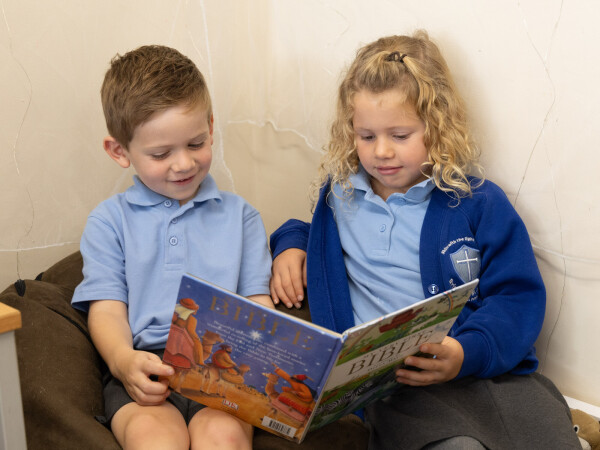
At Brinscall St John’s, we believe that learning to read is one of the greatest gifts we can give a child.
From the moment children join our school, we want them to experience the joy, excitement and wonder that books can bring. We aim to nurture children who not only learn to read successfully, but who love stories, enjoy talking about books and grow into confident, curious readers.
Our classrooms are places where stories are shared, rhymes are enjoyed, new words are discovered and books open windows into new worlds. Through high-quality phonics teaching, carefully matched reading books, rich stories, purposeful talk and regular opportunities to read with knowledgeable adults, we ensure that every child is supported to take their next step as a reader.
We recognise that every child’s reading journey is different. Our staff carefully notice what children can already do, celebrate their successes and provide the teaching, practice and support they need to move forward. This reflects our Early Reading Development Framework, where phonics, language, vocabulary, fluency and comprehension work together to develop confident and motivated readers.
Most importantly, we want reading to feel joyful. We want our children to leave Brinscall St John’s seeing themselves as readers: children who choose books, talk enthusiastically about what they have read and understand that reading can help them discover, imagine and learn.
Through reading, our children develop the knowledge, confidence and curiosity to let their light shine.
How We Develop Confident, Fluent Readers
-
Developing confident and fluent readers
At Brinscall St John’s, we know that becoming a successful reader involves much more than learning to decode words. Language comprehension and word recognition develop together, supported by listening, phonics, fluency, vocabulary, comprehension and a love of books.
Phonological awareness and phonics are taught explicitly, systematically and cumulatively, alongside rich stories, information texts, purposeful talk and reading for pleasure. Children have daily opportunities to hear, practise and discuss reading with knowledgeable adults.
We recognise that children develop at different rates. Developmental stages guide our teaching rather than becoming a timetable children are expected to follow. We use assessment to understand what each child can do independently and identify the next small, manageable teaching step. -
The Journey to Becoming a Reader
Learning to read is a journey, and children may move through different aspects of reading development at different rates.
Children begin by developing language, listening and an understanding of print. They enjoy songs, rhymes and stories, talk about pictures and experiences, and begin to understand that print carries meaning and that books have familiar features.
They develop their ability to hear and work with sounds, noticing rhyme and sounds within words and beginning to blend and segment spoken words.
As children are introduced to phonics, they learn letter–sound correspondences and use these to blend words when reading and segment words when writing. They begin to read short, carefully matched decodable texts.
With practice, reading becomes increasingly accurate and automatic. Children apply their growing phonic knowledge, recognise familiar words more readily and read sentences and connected texts with increasing accuracy and phrasing.
Ultimately, we want children to become fluent, purposeful and increasingly independent readers who read accurately and expressively, monitor their own understanding, talk confidently about what they have read and increasingly make their own reading choices.
-
Phonological Awareness – Hearing and Playing with Sounds
Before and alongside learning phonics, children need lots of opportunities to notice, listen to and work with the sounds of spoken language.
Children listen for and compare environmental and speech sounds and enjoy rhymes, songs, alliteration and repeated refrains. They learn to hear syllables, recognise words that rhyme or begin with the same sound and develop their understanding of onset and rime and individual phonemes.
Children learn to blend spoken sounds together to make words and segment words into their individual sounds. As they become ready, they progress to increasingly complex sound manipulation.
These experiences are taught through clear, brief modelling and plenty of playful oral practice. As appropriate, links are made between the sounds children hear and say and the letters that represent them. -
Phonics and Word Reading
Phonics is taught explicitly, systematically and cumulatively. Children learn how individual letters and groups of letters represent sounds and use this knowledge to read and spell words.
Teaching includes revisiting previous learning, introducing and modelling new letter–sound correspondences or spelling patterns, practising saying sounds and recognising and forming graphemes, blending sounds to read words and segmenting words to spell them.
Children then apply their learning in words, phrases, sentences and carefully matched decodable books.
We teach children to blend through the whole word rather than guessing from a picture, the first letter or the context of a sentence.
Children also develop recognition of common words that are not yet fully decodable using the correspondences they have been taught. Adults explicitly explain the irregular parts of these words and revisit them through meaningful reading and writing.
-
Building Fluency
As children's decoding becomes increasingly secure, we help them develop fluency – accurate word reading at an appropriate pace and with phrasing that supports meaning.
Adults model expressive reading and appropriate phrasing. Children experience echo reading, choral reading and supported rereading and have opportunities to read aloud to an adult or partner.
We use short, purposeful rereading of texts children can mostly decode and talk about how punctuation affects the way we read.
We always prioritise accuracy and meaning over speed. Reading should never become a race. Where a child is working very hard to decode, we return to appropriately matched texts and strengthen the underlying knowledge they need.
-
Developing Vocabulary and Oral Language
Talking and listening are at the heart of becoming a successful reader.
Children hear and use a rich range of vocabulary through conversations, stories and information texts. Adults carefully select useful and interesting words, explain their meanings in child-friendly language and connect new vocabulary to children's existing knowledge.
New words are revisited throughout the day and in different contexts, and children are encouraged to describe, compare, explain, ask questions and use new vocabulary themselves.
We value children's home languages and make connections between languages where possible.
Reading aloud remains an important part of school life. Through carefully chosen rich texts, children encounter language and ideas that they may not experience in everyday conversation or yet be able to access through their own independent reading. -
Understanding What We Read
Comprehension begins with listening and conversation and develops as children encounter increasingly complex texts. We teach comprehension alongside word recognition rather than waiting until children can decode fluently.
Before reading, we build relevant background knowledge, introduce the text and encourage children to make predictions.
During reading, adults model their thinking, clarify meaning, ask questions and make connections. Children are encouraged to recognise when something does not make sense and gradually learn strategies to help them repair their understanding.
After reading, children retell, discuss and respond to characters, events, information and ideas and make connections with other texts and experiences.
Children progressively learn to recall and sequence information, describe characters and settings, make simple inferences, explain their preferences using evidence, identify similarities and differences between texts and ask and answer questions.
We recognise that children may demonstrate their understanding in different ways, including through talk, drawing, gesture or their strongest language where appropriate
Early Reading in Reception and Year 1
-
In Reception
Our youngest children are immersed in conversation, listening, songs, rhymes, stories and meaningful play.
Books are shared every day and adults model enjoyment, curiosity and how to handle and explore books. Children develop sound awareness through playful oral activities and take part in planned phonics teaching, with frequent opportunities to practise and apply what they have learned.
Staff observe children's language, engagement and responses during everyday interactions so that teaching continually responds to children's development.
-
In Key Stage 1
As children move through Key Stage 1, phonics and spelling continue to be taught through a clear, cumulative sequence.
Children regularly practise reading decodable texts that correspond to the phonics content they have been taught. At the same time, they continue to experience daily reading aloud, vocabulary teaching and discussion around a rich and varied range of texts.
We develop fluency through accurate, supported rereading and adult modelling and gradually increase opportunities for independent reading choices and reading across the curriculum.
Comprehension continues to be taught alongside decoding, with appropriate support for children who are still consolidating their word recognition.
How We Assess and Support Reading
-
Assess
Assessment is part of everyday teaching. It is ongoing, proportionate and directly connected to what we teach next.
We consider more than one source of evidence. A single reading, score or observation does not determine a child's overall reading profile.
Staff consider children's listening and oral language, phonological awareness, phonics and word reading, fluency, comprehension, engagement and independence. This includes whether children enjoy and choose texts, sustain their attention and know when to seek help or use a taught strategy when meaning becomes unclear.
Our assessment process follows a simple cycle:
Observe → Identify → Respond → Recheck → Share
We observe children reading and talking about texts in familiar, low-pressure situations. We identify what is secure and the precise point of difficulty, respond with a focused teaching step and then recheck the skill in a fresh example or text.
We keep brief, purposeful records of what children can do and what will be taught next and share progress and practical next steps with families and relevant colleagues.
-
Supporting Every Child to Succeed
Every child is different, and some children will need additional practice, different approaches or further support to become successful readers.
Where a child is not making expected progress, we provide additional, frequent practice that is explicit and carefully sequenced. We ensure that texts and activities allow children to demonstrate what they know without creating unnecessary barriers.
Support might include clear speech, visual prompts, practical resources, repetition, additional thinking time or accessible text formats.
For multilingual learners, we carefully distinguish between children's developing knowledge of English and their underlying reading knowledge. We value and build upon home-language strengths while providing meaningful opportunities to develop English vocabulary and comprehension.
For children with speech, hearing, vision or other identified needs, we work closely with families and relevant specialists and follow individual plans.
We do not label children on the basis of a single assessment. Progress is reviewed regularly and support is adapted as children's needs change.
Working in Partnership with Parents
-
Parents
Families play a hugely important part in children's reading journeys.
We encourage short, positive and regular reading experiences at home. This might mean listening to your child read, sharing a favourite story together, talking about the pictures, revisiting a much-loved book or sharing stories in your home language.
Rereading familiar books is valuable: it helps children develop confidence and fluency. Most importantly, reading at home should provide opportunities for children and their families to talk, enjoy books and share the pleasure of reading together.
Our aim is simple: for every child to become a confident, fluent and enthusiastic reader. We meet children where they are, carefully teach their next steps and make sure that books, stories and reading for pleasure remain at the heart of their journey.
At Brinscall St John’s, we want every child to discover that reading gives them the knowledge, imagination and confidence to shine.
Subject Documents
-
BSJ EARLY READING FRAMEWORK OFFER
-
Spirituality in Phonics and Early Reading
-
Handwriting Letter Formation Patter for Red Rose Phonics
-
Common Exception Words Years 1 and 2
-
100 Tricky and High Frequency Words that are Vital to Fluent, Accurate Reading
-
200 Next Tricky and High Frequency Words that are Vital to Fluent, Accurate Reading