
CurriculumEnglish - Reading
Reading at Brinscall St John's
At Brinscall St John’s, we believe that reading is one of the greatest gifts we can give a child.
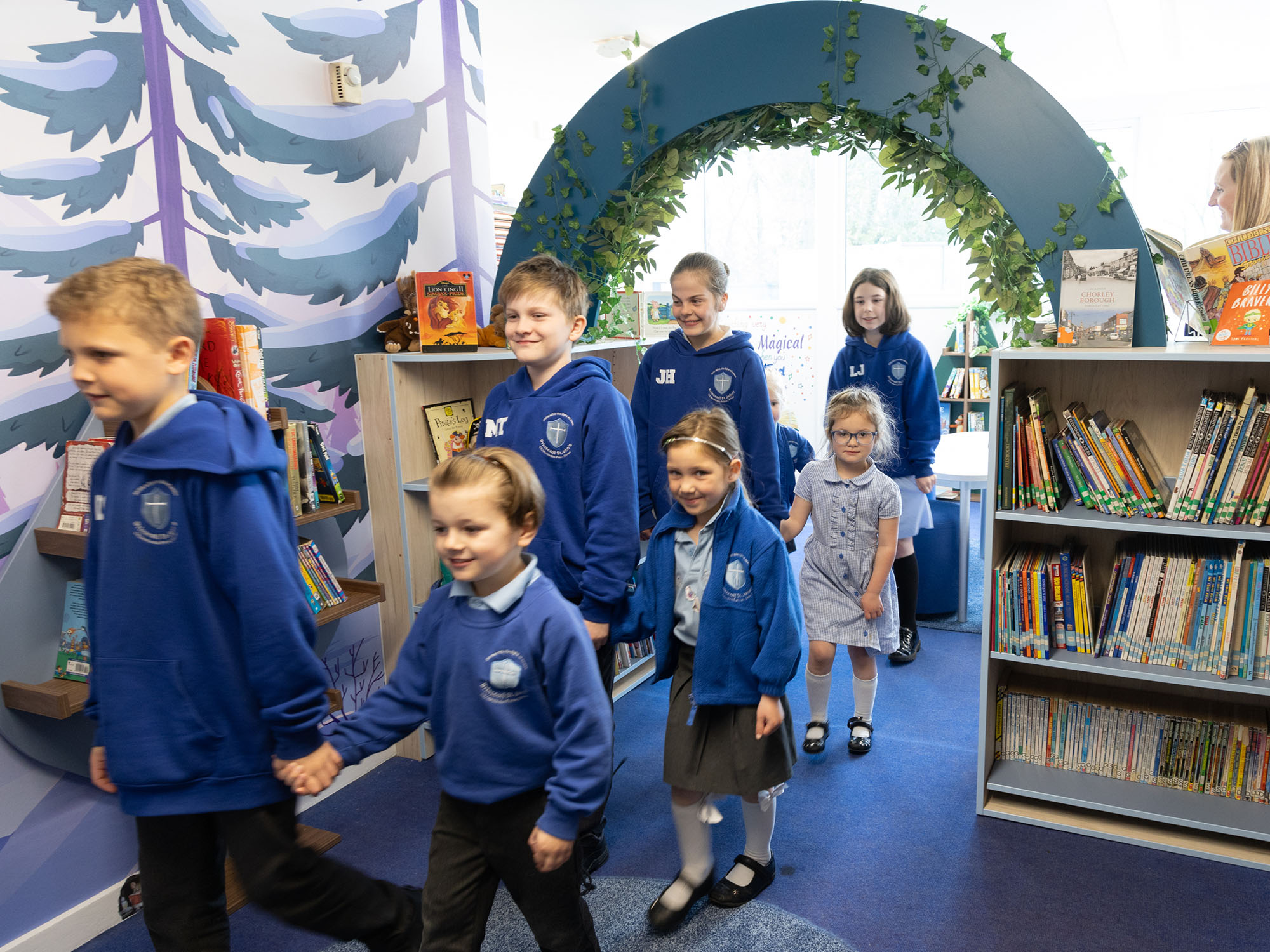
Throughout their time in the juniors, we want children to experience the joy, excitement and wonder that books can bring. We nurture confident, curious readers who enjoy reading for pleasure and recognise how reading can help them explore ideas, people and new worlds.
Our classrooms are places where children encounter a wide range of authors, genres and class novels, discover new vocabulary and share thoughtful discussion. Through regular opportunities to read, we help children develop fluency, stamina and comprehension, and learn to make inferences, ask questions and consider different viewpoints.
We recognise that every child’s reading journey is different. Our staff build on what children already know and provide the teaching, practice and support they need to take their next steps. Through our reading curriculum, we develop independent, critical readers who can understand, discuss and evaluate what they read. Children who need additional help, including phonics catch-up, receive targeted support.
Most importantly, we want reading to feel joyful. We want our children to leave Brinscall St John’s seeing themselves as readers: children who choose books, talk enthusiastically about what they have read and draw on reading to discover, imagine and learn.
Through reading, our children develop the knowledge, confidence and curiosity to let their light shine.
Developing Confident and Fluent Readers
-
Developing Confident and Fluent Readers
At Brinscall St John’s, we know that becoming a successful reader involves more than decoding words. Children build on their word-recognition skills to read accurately and fluently, while developing the language and comprehension they need to understand, discuss and enjoy increasingly challenging texts.We teach children to apply their phonics and decoding knowledge confidently, including when they encounter unfamiliar words. Reading widely across stories, poetry, plays, information texts and class novels helps children develop fluency, stamina, vocabulary and a love of books. They read with knowledgeable adults and independently, with regular opportunities to practise and discuss their reading.Children develop at different rates. We use assessment to understand what each child can do independently and identify an appropriate next step. Where children still need help with decoding, including phonics catch-up, we provide focused, respectful support.
The Journey to Becoming a Reader
-
The Journey to Becoming a Reader
Reading is a continuing journey. As children grow, they build on secure decoding skills and develop the fluency, understanding and independence to read with purpose.Children apply their decoding and word-reading knowledge to read unfamiliar and longer words. They use prefixes, suffixes, root words and context clues to work out meanings, and reread or self-correct when a word or passage does not make sense.With regular practice, children read connected texts with increasing accuracy, expression and stamina. They learn to use punctuation and phrasing to support meaning, and to adapt their reading to different kinds of texts.As their experience grows, children read across a broad range of genres, authors and subjects. They retrieve information, summarise key ideas, make and explain inferences, predict what might happen and compare characters, events and ideas across texts.Ultimately, we want children to become fluent, purposeful and increasingly independent readers. They monitor their understanding, support their ideas with evidence, consider an author’s choices and viewpoints, and make thoughtful reading choices of their own.
Building Fluency
-
Building Fluency
As children apply their decoding skills with increasing confidence, we help them develop fluency: accurate reading at an appropriate pace, with expression and phrasing that support meaning.Adults model fluent, expressive reading. Children practise reading aloud and rereading appropriate texts, both independently and with an adult or partner. They learn to use punctuation, sentence structure and knowledge of the text to guide their phrasing and expression.Rereading is purposeful: it helps children strengthen accuracy, develop stamina and deepen their understanding. We always prioritise accuracy and meaning over speed. Reading is not a race. If decoding is making reading difficult, we provide appropriately adapted texts and targeted teaching to help children build the skills they need.
Developing Vocabulary and Oral Language
-
Developing Vocabulary and Oral Language
Discussion and listening help children deepen their understanding of texts and develop the vocabulary to express their ideas.Children encounter a rich range of vocabulary through stories, class novels, poetry, information texts and conversation. Adults explicitly teach useful and interesting words, connect them to children’s existing knowledge, and revisit them in different contexts.Children learn to use context clues to explore unfamiliar words, and to draw on knowledge of root words, prefixes and suffixes to understand how words are related and how their meanings change. They are encouraged to explain, compare, question and use new vocabulary in their own discussions.We value children’s home languages and make connections between languages where possible. Reading aloud remains an important part of school life, giving children access to rich language, ideas and texts that may be beyond their current independent reading.
Understanding What We Read
-
Understanding What We Read
Comprehension is taught alongside fluent word reading. As children encounter a wider range of texts, they develop strategies to understand, discuss and evaluate what they read.When reading, we introduce the text and build relevant background knowledge. Children consider titles, themes and what they already know to make predictions and prepare to engage with the text.During reading, adults model their thinking, clarify meaning, ask questions and make connections. Children learn to notice when something does not make sense and use strategies such as rereading, checking context and asking questions to repair their understanding.After reading, children discuss and respond to characters, events, information and ideas. They retrieve key details, sequence events, summarise sections, make inferences and explain their thinking using evidence from the text. They explore how vocabulary, structure and an author’s choices shape meaning, and compare texts, viewpoints and ideas.Children show their understanding in different ways, including through discussion, written responses and creative work. We encourage them to share their ideas respectfully and to listen and respond to the interpretations of others.
The Structure of Reading Teaching
-
The Structure of Reading Teaching
From Year 2 upwards, children take part in daily guided reading sessions. On Mondays, the adult leading the session models an ‘expert’ read, encouraging children to enjoy the text as they follow along. On Tuesdays, children focus on fluency, with a specific teaching point to work towards. Wednesdays are used to explore vocabulary and develop understanding, including through context clues and word structure. Thursdays and Fridays involve varied tasks that support comprehension, such as retrieval, inference, prediction, summarising, evaluation and comparing texts.
How We Assess and Support Reading
-
How We Assess and Support Reading
Assessment is part of everyday teaching. It is ongoing, proportionate and directly connected to what we teach next.We consider more than one source of evidence. A single reading, score or observation does not determine a child’s overall reading profile.Staff consider children’s decoding and word reading, fluency, vocabulary, comprehension, engagement and independence. This includes how well children understand and discuss texts, sustain attention, choose reading materials and use a taught strategy when meaning becomes unclear.Our assessment process follows a simple cycle:Observe → Identify → Respond → Recheck → ShareWe observe children reading and talking about texts in familiar, low-pressure situations. We identify what is secure and the precise point of difficulty, respond with a focused teaching step and then recheck the skill in a fresh example or text.We keep brief, purposeful records of what children can do and what will be taught next. We share progress and practical next steps with families and relevant colleagues.
Supporting Every Child to Succeed
-
Supporting Every Child to Succeed
Every child is different, and some children need additional practice, different approaches or further support to become successful readers.Where a child is not making expected progress, we provide additional, frequent practice that is explicit and carefully sequenced. For children who need it, this may include focused phonics catch-up to strengthen decoding. We choose texts and activities that help children demonstrate what they know without creating unnecessary barriers.Support might include visual prompts, practical resources, repetition, additional thinking time or accessible text formats.For multilingual learners, we carefully distinguish between children’s developing knowledge of English and their underlying reading knowledge. We value and build on home-language strengths while providing meaningful opportunities to develop English vocabulary and comprehension.For children with speech, hearing, vision or other identified needs, we work closely with families and relevant specialists and follow individual plans.We do not label children on the basis of a single assessment. Progress is reviewed regularly and support is adapted as children’s needs change
Working in Partnership with Parents
-
Working in Partnership with Parents
Our aim is simple: for every child to become a confident, fluent and enthusiastic reader. We meet children where they are, carefully teach their next steps and keep books, stories and reading for pleasure at the heart of their journey.Reading at home can help children build fluency, stamina and confidence. We encourage families to make time for regular home reading, talk together about books and share recommendations. Children can discuss characters, events, new vocabulary and what they think about a text.At Brinscall St John’s, we want every child to discover that reading gives them the knowledge, imagination and confidence to shine.